
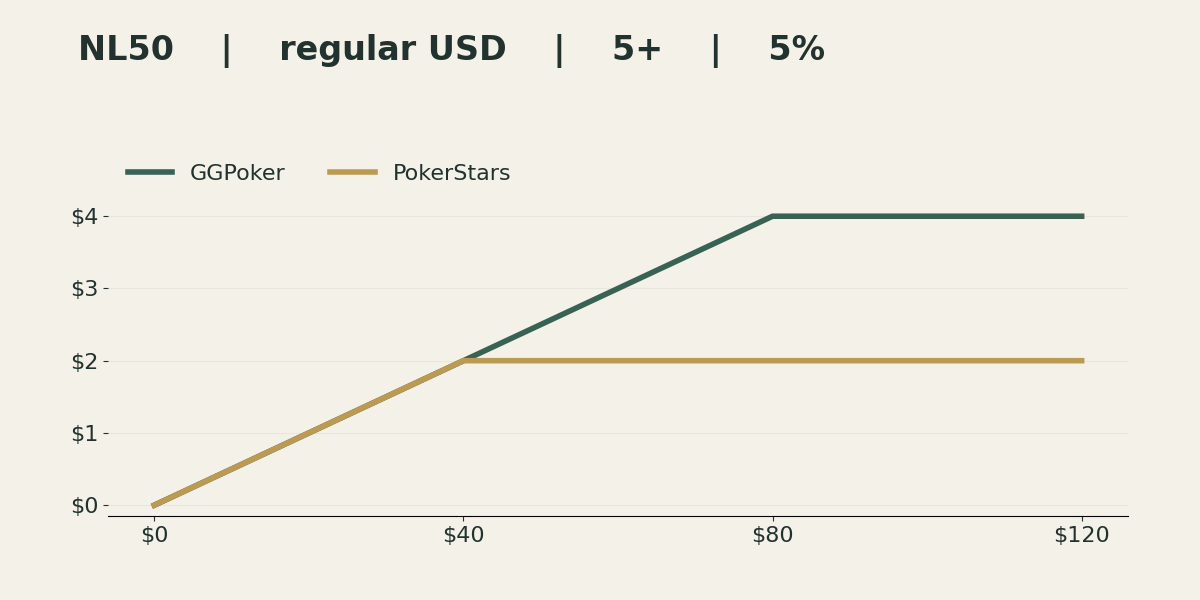
For an eligible $100 regular NL50 pot in the published 5+ player bracket, the schedules used here produce $2 of rake at PokerStars and $4 at GGPoker. For a $10 pot in the same bracket, both produce $0.50. The difference appears when one cap is reached before the other.
That gives a useful comparison of those pots. It doesn't establish which room offers the better game, or how much an individual player will pay per 100 hands.
Match the format before matching the fee
This comparison uses the public international .com USD schedules checked for this draft on 2 November 2026: PokerStars' regular no-limit table schedule and GGPoker's regular 6-max Hold'em schedule. Locally licensed clients may have different schedules.
Every example assumes an eligible postflop pot in the 5+ player cap bracket, with six players dealt in and the same eligible pot amount at both rooms. We exclude Zoom, Rush & Cash, antes, special variants, optional services and rewards. These are constructed fee scenarios, not captured hands.
| Regular USD schedule, 5+ bracket | Rate | NL10 cap | NL50 cap |
|---|---|---|---|
| PokerStars | 5% | $1.00 | $2.00 |
| GGPoker 6-max | 5% | $1.00 | $4.00 |
PokerStars specifies that its player count refers to players dealt into the hand. Apply the relevant provider's cap rule; do not use the number reaching showdown as a universal substitute. The scenarios above keep all six players eligible so that the comparison does not depend on a short-handed edge case.
At NL10, these pots tie
Calculate min(5% of the eligible pot, the cap):
| Eligible NL10 pot | PokerStars rake | GGPoker rake | Difference |
|---|---|---|---|
| $5 | $0.25 | $0.25 | $0.00 |
| $20 | $1.00 | $1.00 | $0.00 |
| $50 | $1.00 | $1.00 | $0.00 |
On this restricted comparison, there is no fee winner. A claim that one room is always cheaper at NL10 would need additional conditions or observed data. Changing the cap bracket or format changes the question.
At NL50, the $40 threshold matters
At 5%, PokerStars' $2 cap is reached at $40. GGPoker's $4 cap is reached at $80 in the bracket used here.
| Eligible NL50 pot | PokerStars rake | GGPoker rake | GGPoker minus PokerStars |
|---|---|---|---|
| $10 | $0.50 | $0.50 | $0.00 |
| $40 | $2.00 | $2.00 | $0.00 |
| $100 | $2.00 | $4.00 | $2.00 |
Below $40, the formulas give equal ordinary rake. Between $40 and $80, the PokerStars fee is capped while the GGPoker fee continues to rise. At $80 and above, the gap stays at $2 under these assumptions. At NL50 that difference is four big blinds removed from the pot, not four big blinds charged separately to every player.
Our fee-only preference for large pots in this bracket is PokerStars. It would need to be reconsidered for a different schedule, reward entitlement or game composition. Fee arithmetic cannot measure the skill of the opponents or establish a player's achievable win rate.
Two-player pots can change the comparison
The 5+ bracket is not a room-wide ranking. In the published two-player brackets, regular NL10 has a $1 PokerStars cap and a $0.25 GGPoker cap. At regular NL50, those two-player caps are $0.75 and $1 respectively. These are different conditions from the six-player scenarios above.
For an eligible postflop pot with two players dealt into the hand, the simplified calculation gives:
| Stakes and eligible pot | PokerStars rake | GGPoker rake | Lower ordinary fee in this example |
|---|---|---|---|
| NL10, $10 pot | $0.50 | $0.25 | GGPoker |
| NL50, $25 pot | $0.75 | $1.00 | PokerStars |
Both rows use 5% before the cap. They illustrate why the stakes and player bracket must travel with the conclusion. They do not establish the availability of a dedicated heads-up product or the rules for a partially occupied table. Verify the applicable game and counting rules in the client.
If six players receive cards but only two contest a later street, that is not automatically the same case as a hand dealt to two players. A counterfactual dataset should retain the relevant participation fields, rather than reconstructing a cap from the final pot winner and caller.
A rounding check for smaller pots
Cent rounding can matter near a boundary. For a hypothetical eligible pot of $1.30, 5% is $0.065 before rounding. PokerStars specifies round-half-to-even, which gives $0.06 for this value; a half-up rule would give $0.07. The earlier whole-dollar pot examples avoid this tie and therefore do not establish that both rooms handle every cent boundary identically.
Use the documented rounding rule for the applicable room when calculating a hand-level dataset. If it isn't established, preserve the unrounded model amount and flag the one-cent cases for reconciliation. Do not claim a rounding advantage for either room from an assumed rule.
How not to turn a pot saving into fake bb/100
Multiplying the $2 difference by 100 hands would assume that every hand reaches that pot size, that the comparison applies to every hand and that one player bears the full difference. None of those assumptions follows from the schedule.
Use a player-level ledger instead:
difference in cost, bb/100 = difference in attributed dollars
                             / number of hands * 100 / big blind
A measured 1 bb/100 cost difference over 10,000 NL50 hands would equal $50. That conversion is valid arithmetic. Claiming that the schedules above necessarily create that difference would require evidence about the hands and how pot rake is allocated to the player.
An alternative research design is to apply both schedules to the same eligible pot dataset. That estimates a counterfactual fee difference for a fixed set of pots; it does not predict that the player's hands or opponents would remain the same after changing rooms. Report the dataset, exclusions and player-cost allocation method.
Rewards need a second comparison
The tables use gross ordinary rake. To compare realized net costs, subtract the cash rewards actually received under a consistent definition. Keep base cashback apart from separate promotions and do not value unredeemed points as if they were already cash.
For example, two hypothetical player ledgers could show $500 of attributed rake with $100 returned and $550 of attributed rake with $55 returned. The first net cost is $400 and the second is $495. These are illustrations of the accounting, not rewards claims about PokerStars or GGPoker.
The GGPoker NL10/NL50 companion explains how to measure effective cashback from a consistent account ledger.
For a comparison you can verify later, preserve the two applicable schedules, the exact game definitions and the reward ledger. Report an unknown personal reward rate as unknown. The cap difference is already useful without inventing a full account-level result.
Identical pots (CSV); Dated rate facts (JSON); Worked examples (JSON).