
“GGPoker charges 5%” leaves out the part that can change the bill: the cap. In the public international USD schedule checked for this draft on 2 November 2026, regular 6-max NL50 has a $4 cap in its 5+ player bracket. A 5% calculation reaches that cap at an $80 eligible pot. Smaller pots remain below it.
Keep the format attached to the number. The regular-table schedule is not a substitute for Rush & Cash or a locally licensed client. This article calculates documented fees on stated pots; it does not report an observed player win rate or a database of hands.
Start with the regular 6-max schedule
The following USD values come from GGPoker's Texas Hold'em information page. They apply to its regular 6-max table schedule as retrieved for this review. Bracket labels follow that schedule.
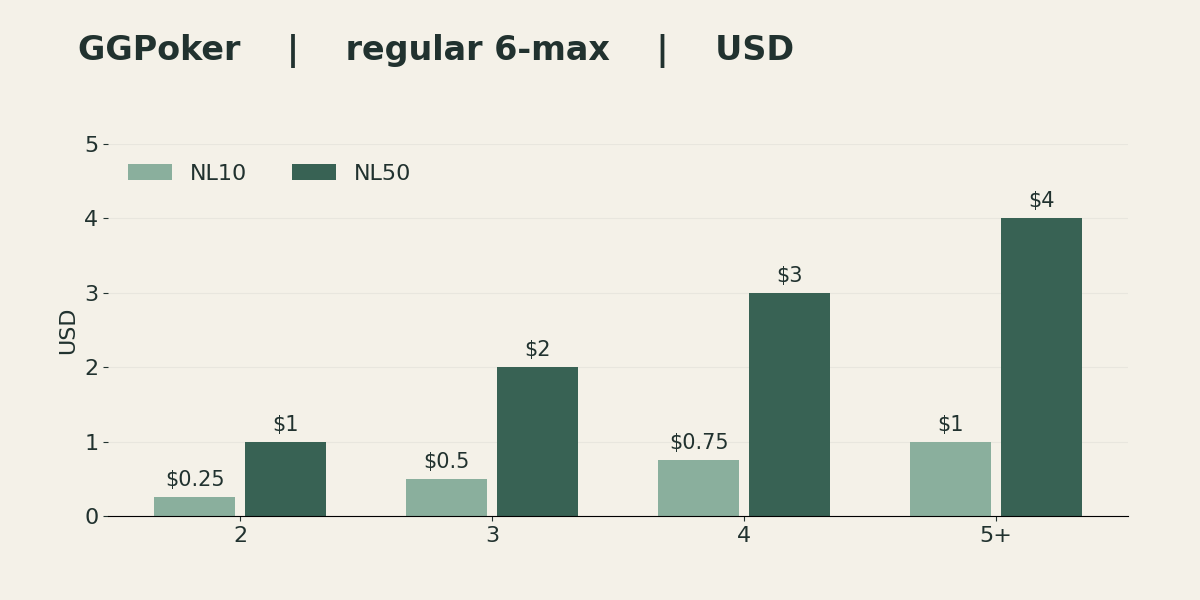
| Stakes | Blinds | Rake rate | 2-player cap | 3-player cap | 4-player cap | 5+ player cap |
|---|---|---|---|---|---|---|
| NL10 | $0.05/$0.10 | 5% | $0.25 | $0.50 | $0.75 | $1.00 |
| NL50 | $0.25/$0.50 | 5% | $1.00 | $2.00 | $3.00 | $4.00 |
NL10 and NL50 refer here to 100-big-blind stake labels, not a claim about a required or default buy-in. The applicable cap also requires the correct player bracket; the number of players left at showdown should not be substituted for the provider's counting rule.
For a pot that is eligible for rake, the basic calculation is:
pot rake = min(eligible pot * rake rate, applicable cap)
At NL50 in the 5+ bracket, an eligible $10 pot produces $0.50 of rake; a $40 pot produces $2; a $100 pot reaches the $4 cap. Those are pot-level amounts. They are not automatically the amount attributed to one player for rewards accounting.
This calculation assumes the relevant pot and cap have been identified correctly. Side pots, returned uncalled bets, eligibility and rounding require their own treatment. Do not calculate a fee on the largest number displayed in a hand history without checking what that number contains.
Rush & Cash needs its own line in a comparison
GGPoker's Rush & Cash page lists 5% rake capped at 3 big blinds, plus a 0.5-big-blind contribution to its Cash Drop pool for pots of at least 30 big blinds. Keep that contribution separate from ordinary rake.
At NL10, 3 big blinds equal $0.30 and 0.5 big blinds equal $0.05. At NL50, the same units become $1.50 and $0.25. A table that shows only “5%” would hide both the different cap and the extra contribution.
Cash Drop receipts can offset some of a particular account's costs, but the contribution and receipt are different entries. Don't subtract the face value of a possible future drop from every hand. Record the contribution when charged and the benefit when actually received.
The regular-table examples in this article do not include Rush & Cash contributions. They also do not assume that every preflop pot is eligible for rake. Check the rules of the specific client and game before applying a percentage to such a hand.
Effective cashback starts with money actually received
GGPoker's Ocean Rewards program distinguishes tier-progression points from GEM rewards. Points are not interchangeable with redeemed money. The operator announced Ocean Rewards as the replacement for Fish Buffet from 30 January 2026; using an old Fish Buffet table as the current international program would be misleading.
For a stated period, calculate:
effective base cashback = cash redeemed from base rewards
                          / rake attributed to that player
Use a consistent definition of attributed rake. The total rake removed from every pot in which a player participated is not necessarily that player's allocated contribution. If the denominator cannot be established, an effective-rakeback percentage is not yet supported.
Match reward earnings to the rake period where possible. Redeeming an older balance this month can inflate a ratio against this month's rake. If the earning period cannot be reconciled, label the result a cash-flow ratio for the reporting window, rather than the cashback rate earned on those hands.
Here is a synthetic account ledger:
| Entry for the same period | Amount |
|---|---|
| Rake attributed to the player | $500 |
| Redeemed base-program cashback | $75 |
| Separate cash promotion received | $25 |
Base cashback is $75/$500 = 15%. All cash rewards in this example total $100/$500 = 20%. Keeping the labels separate lets another reader compare the base program without silently including a one-off promotion.
With only base cashback deducted, the player's net cost is $425. Including the separate cash promotion makes that $400. Unredeemed points, account-specific offers and speculative future redemptions are absent from both totals.
We would use this realized ledger before an advertised maximum when comparing an account's costs. A publicly documented, applicable redemption schedule can support a separate estimate of pending rewards. It still needs its own label and assumptions. This article does not assign a hidden PVI value to the reader or infer a fixed personal cashback rate from the account's skill level.
A cap cannot give you a universal bb/100 number
Big blinds per 100 hands require a hand count and a player-level cost:
cost in bb/100 = attributed cost / hands * 100 / big blind
In a synthetic NL50 sample of 10,000 hands with $1,000 of attributed cost, the result is 20 bb/100. This is arithmetic on a chosen input, not a claim that NL50 players normally pay that amount.
Two players can face the same rate and cap yet generate different costs because their pots, contributions and game mix differ. Avoid converting a public fee table into a claimed population average without hand data and an allocation method.
Reconcile a reward ledger before trusting the percentage
Begin with the opening unredeemed balance, rewards earned during the reporting period, amounts redeemed and the closing balance. Keep the units consistent. A point balance cannot be added directly to a cash redemption unless a documented conversion and its conditions are applied.
Suppose a synthetic report shows $75 redeemed, but $30 of that redemption came from rewards earned before the 10,000-hand sample. Assigning all $75 to the sample would overstate its earned cashback. For that sample, retain the $45 traceable to its own rewards and separately report any remaining earned rewards that have not yet been redeemed.
Promotional balances can have expiry or eligibility conditions. Record these beside an estimated pending value. If the underlying reports cannot connect earnings with hands, show the cash actually received and the limitation; don't reverse-engineer a personal multiplier from the gap.
This reconciliation also prevents double counting. A cash reward credited to the account and later withdrawn is one reward, not two benefits. A withdrawal changes where the money sits; it does not create another rakeback payment.
What to retain for a useful audit
Save the jurisdiction and client, game format, currency, stakes, date and applicable cap bracket. Retain the hand histories or account reports used for the denominator and a separate ledger of redeemed rewards. If formats are mixed, split them before calculating an average.
The broader question of whether a call remains worthwhile after fees belongs in the pot-odds calculation, with the relevant deductions included explicitly. A lower fee alone cannot establish the best game or a positive expected win rate.
Recheck the client's current schedule before relying on these public-documentation figures. If the client differs, preserve that evidence and calculate from the applicable schedule rather than forcing the account to fit this table.
GGPoker caps (CSV); Dated rate facts (JSON); Worked examples (JSON).